
%20(1).webp)
How to Move a Home Gym: Weights, Racks, and Cardio Equipment Without Injury
You move a home gym by breaking it into three separate problems: the heavy iron (plates and dumbbells), the structural steel (racks, benches, and cages), and the powered cardio machines (treadmills, bikes, ellipticals). Each category fails in a different way if you treat it like ordinary furniture. Weight plates crack floors and subfloors if you carry too many at once. Racks and cages are bolted assemblies that were never designed to be lifted whole. Cardio machines have electronics, belts, and hydraulics that get thrown out of alignment by rough handling or the wrong orientation in a truck.
Home gyms have become common enough in Chattanooga garages and basements that this comes up on almost every quote call once a customer mentions a squat rack or a stack of bumper plates. Most general moving advice skips this equipment entirely because it looks like "just weights." It isn't. Here is how to move a home gym in a way that protects your equipment, your floors, and your back.
How Much Do Weight Plates and Dumbbells Really Weigh When You Add Them Up?
A modest home gym often has 300 to 600 pounds of iron once you count plates, dumbbells, and kettlebells together, and that total is the single biggest reason home gym moves go wrong. People underestimate the cumulative weight because each piece feels manageable on its own.
Never carry loaded plate trees or full dumbbell racks as one unit. Break weight down into small, boxable batches instead:
- Use small, heavy-duty boxes (liquor or produce boxes work well) and fill them no more than half full with plates before checking the weight.
- Wrap rubber-coated plates individually if they will rub against metal plates or hardware in transit, since friction can tear the coating.
- Load loose plates and dumbbells low in the truck, against the wall separating the cab, so their weight doesn't shift during braking.
- Never stack loose plates directly on furniture or appliances. The point pressure will dent wood and scratch finishes fast.
If you are worried about scuffing hardwood or tile while carrying iron through the house, set down a runner or moving blankets along the path first. It is a lot cheaper than refinishing a floor.
Do You Need to Fully Disassemble a Squat Rack or Power Cage?
Yes, in almost every case. Power racks, cages, and multi-station machines are bolted frames, not solid objects, and moving them assembled risks bent uprights, stripped bolts, and a rack that never sits quite square again.
Before moving day, work through the frame methodically:
- Photograph the assembled rack from several angles before you touch a wrench. You will thank yourself during reassembly.
- Remove pull-up bars, dip attachments, lat pulldown arms, and safety pins first. These smaller pieces are easy to misplace, so bag and label the hardware for each one separately.
- Take the rack down to its main upright sections rather than trying to keep it as one welded-feeling block. Most consumer racks bolt together in sections specifically so they can be flat-packed.
- Keep all bolts, washers, and Allen wrenches in a labeled zip-top bag taped to the matching frame section, not loose in a toolbox that also moves.
- Wrap upright posts and any exposed threading with moving blankets to prevent dings that make reassembly harder later.
Benches usually just need the seat pad protected and the frame kept upright to avoid bending the adjustment pins. If your rack is a true commercial-grade cage bolted to the floor, treat it more like specialty equipment: our guide on moving oversized items like pool tables and gun safes covers when it makes sense to bring in extra hands for anything this bolted-down and heavy.
How Do You Move a Treadmill or Exercise Bike Without Ruining the Motor?
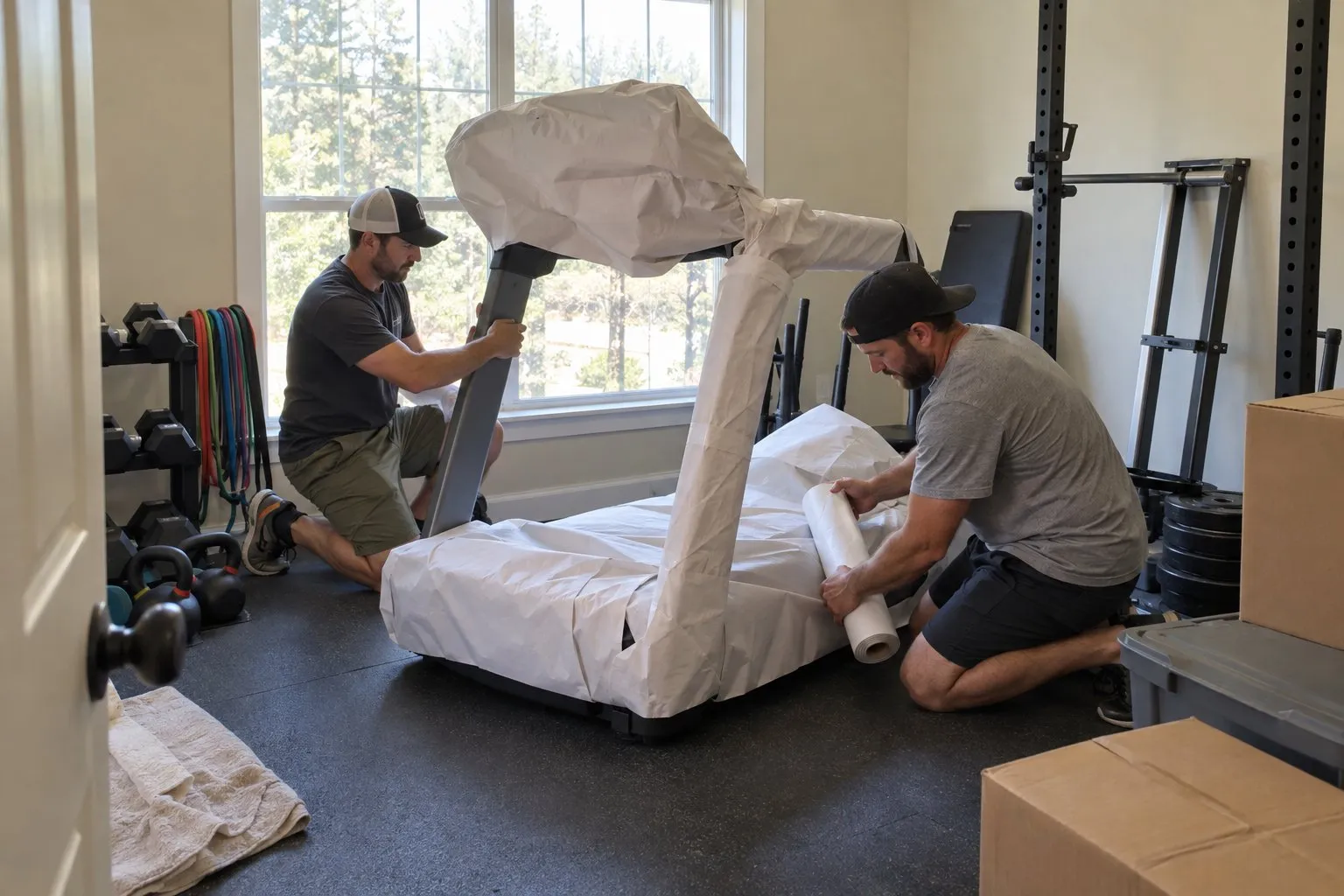
Cardio machines need to travel upright whenever possible, with the deck locked or folded per the manufacturer's setting, because tilting them onto their side can let oil pool away from motor components or strain belt tension in ways that shorten the machine's life. Treadmills in particular are deceptively heavy and top-heavy at the same time, which makes them one of the more injury-prone items in a home gym move.
- Fold and lock the deck if your treadmill has a folding frame, and confirm the lock is engaged before it goes anywhere near a dolly.
- Unplug and coil cords, then remove or secure the safety key so it doesn't get lost separately from the machine.
- Use an appliance dolly with straps rather than trying to walk a treadmill on its wheels across gravel, thresholds, or gaps between the house and the truck ramp.
- Keep exercise bikes and ellipticals upright in the truck and braced against a wall, never laid flat under other boxes.
- Avoid moving cardio equipment in extreme heat or cold when possible. Sitting for hours in a hot truck can affect belts, lubricants, and electronic displays.
If your treadmill or elliptical is on the larger, commercial-style side, it starts to behave more like an appliance than a piece of furniture. Our guide to moving a washer and dryer walks through the same core idea of handling heavy, motor-driven equipment carefully, even though the machines are different.
Should You Move a Home Gym Yourself or Hire Professional Movers?
A small setup of dumbbells, a bench, and resistance bands is manageable solo with the right boxes and a hand truck. A full rack, loaded barbell, stacked plates, and a treadmill is a two-or-more-person job even for experienced DIY movers, mostly because of how quickly the combined weight becomes unsafe to carry up or down stairs.
Weigh these factors before deciding:
- Total weight of iron alone. If it's pushing past a few hundred pounds, plan for multiple trips or extra hands regardless of who does the carrying.
- Stairs, tight hallways, or a garage that opens onto a slope. Any of these turn a straightforward carry into a real fall risk with heavy plates or an off-balance treadmill.
- Whether your rack is bolted to studs or a concrete slab, which adds a removal step most people don't plan for until moving day is already underway.
- How much your equipment cost to replace. Higher-end cardio machines and racks are worth protecting with professional handling rather than risking a drop.
If you decide to bring in help for part of the move, our packing services team can box up plates, accessories, and smaller equipment correctly so the heavy lifting on moving day is limited to what actually needs a dolly and a second set of hands.
How Should You Load a Home Gym Into the Truck?
Load order matters more with a home gym than with most rooms in the house, because you're combining very heavy, low items (plates) with tall, top-heavy items (racks, treadmills) that need bracing against something solid.
- Load loose weight and dense boxes first, low and toward the front of the truck, to keep the load's center of gravity low and stable.
- Stand rack frame sections and bench frames against the truck wall, secured with straps, rather than laying them flat where they can be crushed.
- Position cardio machines upright along a wall with strapping, never stacked under other items.
- Leave your hardware bags, tools, and assembly photos in a single clearly marked box that travels with you rather than buried in the truck. You will need them the moment you start reassembling.
For local moves within the Chattanooga area, our local moving team handles this kind of mixed heavy-and-bulky load regularly and can advise on truck placement during your quote call.
Setting Up Your Home Gym in the New Space
Reassembly goes fastest when you resist the urge to rush it. Unpack hardware bags by frame section, refer back to your photos, and build the rack or cage before you bring in a single plate, so you're not maneuvering around loose iron while you work.
Check that your new floor can handle the load before you drop everything back into place. Concrete slabs are generally fine; second-floor rooms over standard joist framing may need rubber mats or plywood spreaders under a loaded rack to distribute the weight properly. This is also the moment to check bolts are torqued back to spec rather than just "snug," since a rack that shifts under load is a real safety issue, not just a cosmetic one.
Frequently Asked Questions
Can you move a treadmill without disassembling it?
Most treadmills only need the deck folded and locked, not full disassembly. Remove the safety key, unplug and coil the cords, and move it upright on an appliance dolly. Full disassembly is usually only necessary for commercial-grade machines or tight stairwells.
How do you pack weight plates for moving without hurting your back?
Split plates into small, heavy-duty boxes filled no more than halfway, then check the weight before sealing. It is safer to make several trips with lighter boxes than to carry one box loaded past a comfortable lifting weight.
Do movers charge more for home gym equipment?
Pricing depends on total weight, disassembly needs, and access (stairs, tight hallways, slabs). A home gym with a loaded rack and cardio machines generally takes more time and crew than a similarly sized room of regular furniture, which can affect the estimate.
What is the best way to transport a power rack or squat cage?
Break the rack down into its bolted sections rather than moving it assembled. Bag hardware by section, wrap the uprights in moving blankets, and stand the sections against the truck wall secured with straps rather than laying them flat.
Is it safe to lay an exercise bike or elliptical on its side during a move?
It is best avoided. Cardio machines with hydraulics, belts, or fluid-based resistance systems can be thrown out of alignment when tilted for extended periods. Keep them upright and braced whenever the truck layout allows it.


Frequently Asked Questions
Most treadmills only need the deck folded and locked, not full disassembly. Remove the safety key, unplug and coil the cords, and move it upright on an appliance dolly. Full disassembly is usually only necessary for commercial-grade machines or tight stairwells.
Split plates into small, heavy-duty boxes filled no more than halfway, then check the weight before sealing. It is safer to make several trips with lighter boxes than to carry one box loaded past a comfortable lifting weight.
Pricing depends on total weight, disassembly needs, and access (stairs, tight hallways, slabs). A home gym with a loaded rack and cardio machines generally takes more time and crew than a similarly sized room of regular furniture, which can affect the estimate.
Break the rack down into its bolted sections rather than moving it assembled. Bag hardware by section, wrap the uprights in moving blankets, and stand the sections against the truck wall secured with straps rather than laying them flat.
It is best avoided. Cardio machines with hydraulics, belts, or fluid-based resistance systems can be thrown out of alignment when tilted for extended periods. Keep them upright and braced whenever the truck layout allows it.